.svg)


8 Athangudi Tile Ideas for Pooja Rooms With Traditional Character
ByHeena Dhiman

Wed , Jul 29 , 2026

Read Time: 5 Min


 Copied!
Ask anyone what the most important corner of their home is, and most Indians will point to the same place without thinking twice. The pooja room. It is where the day starts, where good news gets shared first, and where the house feels most like itself. A space that carries that much meaning should never be an afterthought, and the tiles you choose for it are a bigger decision than most people realise.
For homes that want that space to feel genuinely rooted, Athangudi tiles have been the answer for generations. Handmade in Tamil Nadu using natural pigments and age-old methods, they bring bold colour and traditional Indian patterns to pooja rooms in a way that feels earned rather than decorative. That is why they remain among the most sought-after traditional pooja room tiles in the country.
If you are planning a pooja room or looking to redo one, here are 7 Athangudi tile ideas for pooja rooms that bring genuine traditional character, along with practical guidance on how to use each one well.
Floral Motif Floor Tiles for a Timeless Base
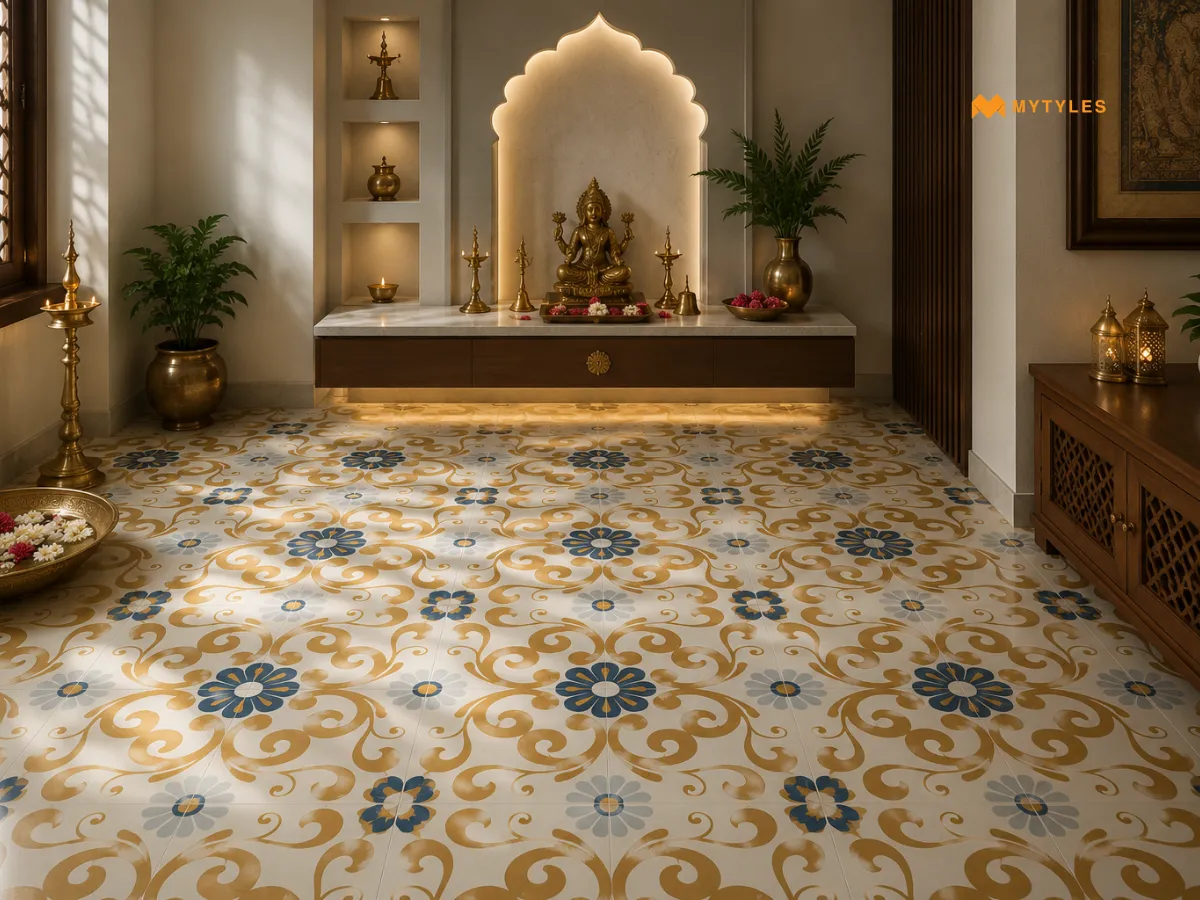
Flowers have always been central to Indian devotional spaces. Lotus patterns, jasmine, and marigold-inspired designs appear in temple art, rangoli, and ritual offerings. It makes sense, then, that Athangudi tiles with floral motifs feel so at home in a pooja room.
Floral tiles in shades such as deep reds, saffron yellows, or indigo blues work beautifully as pooja room floor tiles. The pattern creates a visual centrepiece that draws the eye inward, toward the deity, without competing with the rest of the space.
Design tip:
Pair floral Athangudi floor tiles with plain, light-coloured walls. Let the floor do the talking. A white or cream wall finish makes the tile colours pop without making the room feel heavy.
Geometric Border Tiles for a Defined, Structured Look
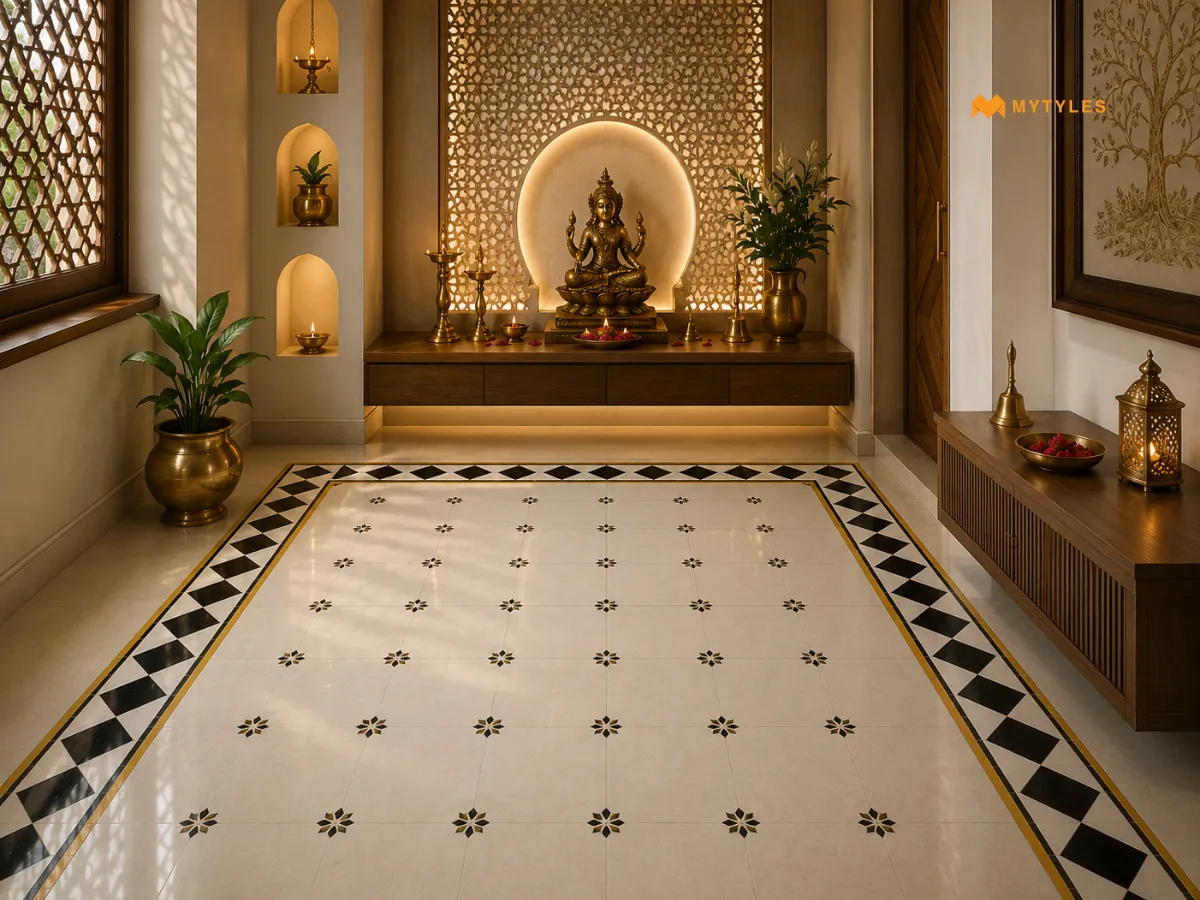
Not every Athangudi tile design idea needs to take over the entire floor. Sometimes, a border does the job better. A geometric border running along the perimeter does something quiet but powerful. It gives the pooja room floor a sense of frame and intention, qualities that sit well in a space built around ritual.
Interlocking diamonds, star points, and chevron runs. These are the shapes that show up repeatedly in Athangudi geometric tiles. When laid as a border around plainer patterned floor tiles, they define the boundary of the space the way a good frame defines a painting. Nothing overdone, but nothing left to chance either.
Design tip:
Use a darker border shade against a lighter centre tile to define the frame clearly. Black with mustard, or navy with ivory, are classic combinations that never feel overdone.
Terracotta Color Tiles for a Warm, Earthy Ambience
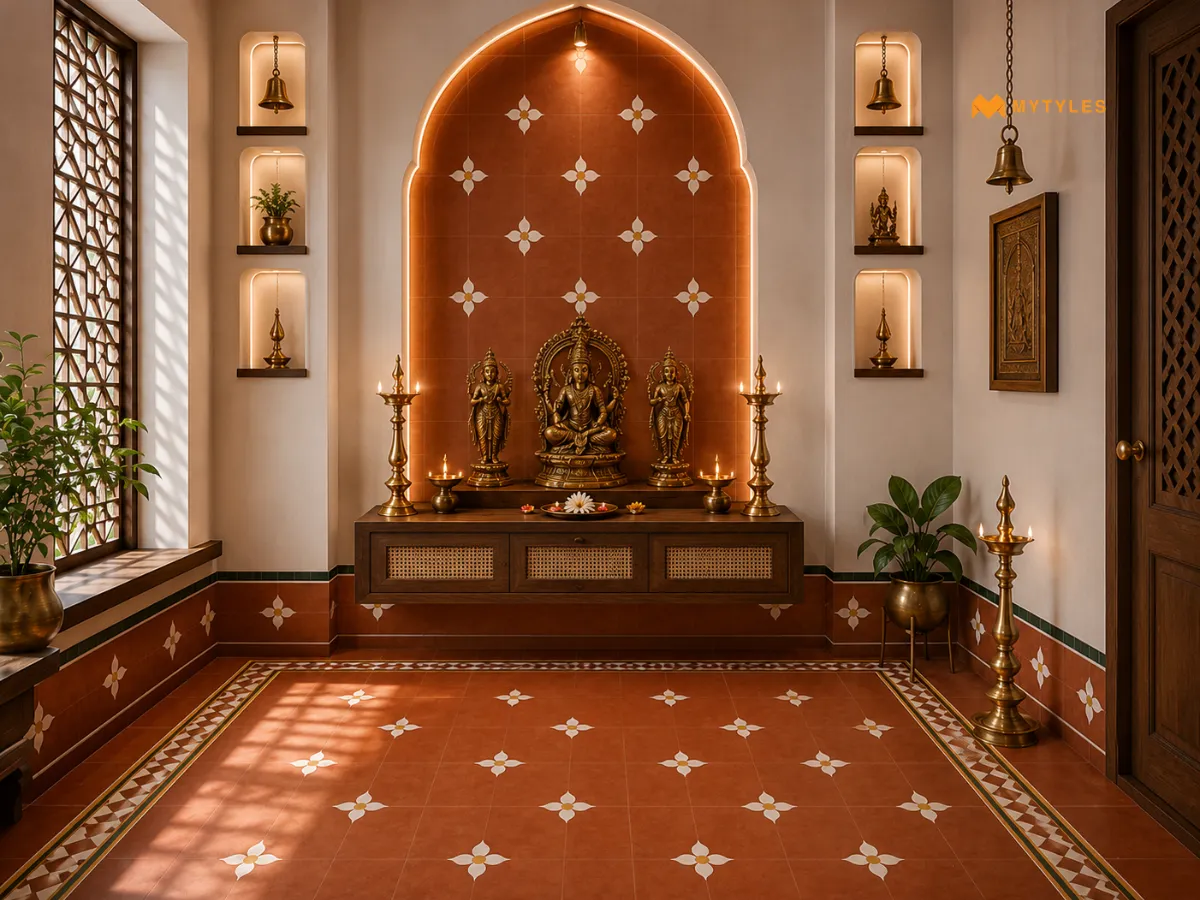
There is a reason terracotta appears in so many temple floors across South India. The colour is grounding. Warm without being loud. Natural without being dull. Terracotta colour tiles in the Athangudi style carry that same quality, especially when the patterns are kept slightly muted rather than sharply contrasted.
Pooja rooms that open directly into a living or dining area benefit from this kind of continuity. Earthy floor tiles in terracotta tones let the warmth carry through without a visual break. Maintenance is another quiet advantage. Earthy tones handle daily foot traffic, incense ash, and fallen flower petals far better than white or pale tiles, where every little thing shows up immediately.
Design tip:
Combine terracotta Athangudi tiles with brass or copper fixtures in the mandir unit. The metallic tones against the earthy floor create a look that feels deeply rooted in Indian craft tradition.
Full-Wall Athangudi Tiles for a Bold, Temple-Inspired Statement
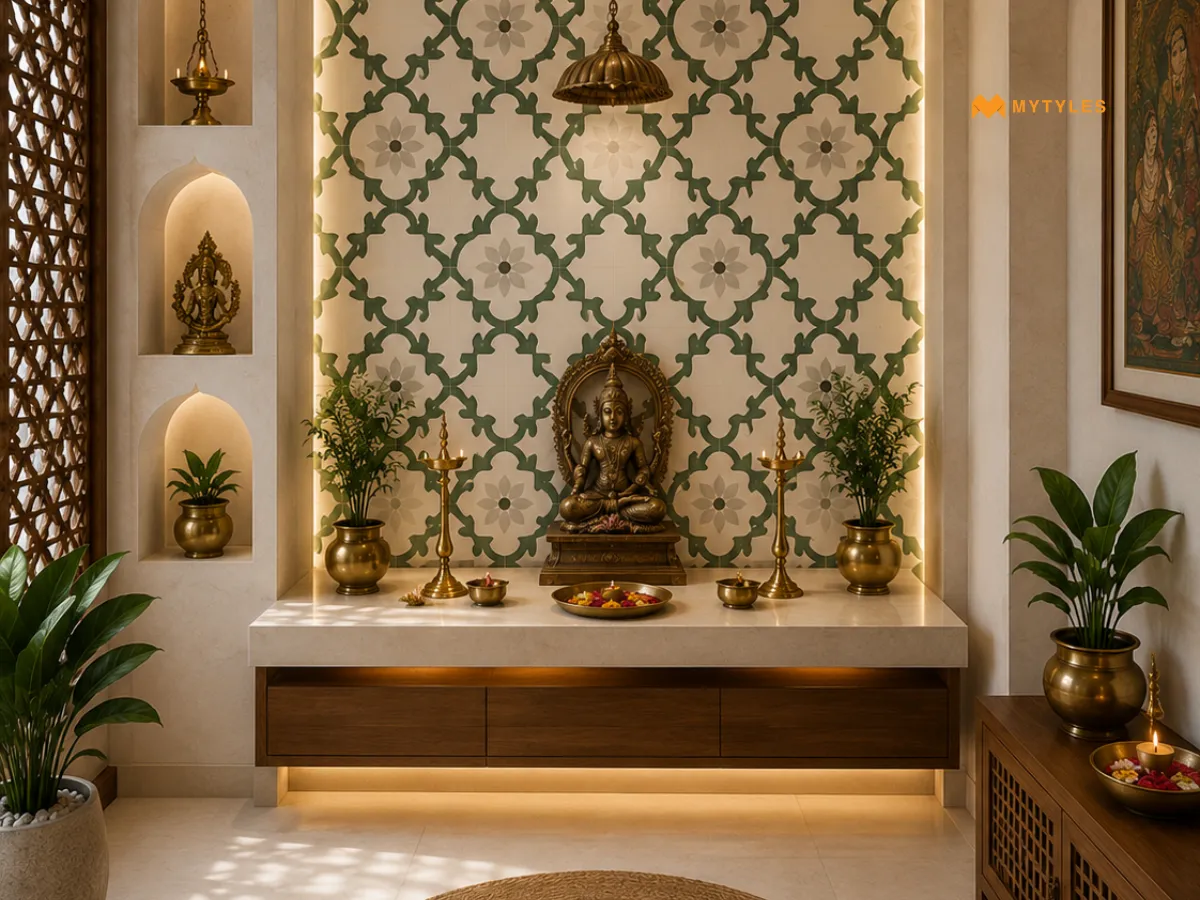
Most people use Athangudi tiles for pooja room floors. But applying them to a wall, specifically the wall behind the deity, creates something far more striking. It turns the back wall into an altar in its own right.
Pooja room wall tiles in Athangudi designs with deep jewel tones, think cobalt blue, forest green, or vermilion, create a dramatic backdrop that elevates even a simple wooden mandir unit. The handmade quality of the tile gives the wall texture and depth that paint or wallpaper cannot match.
Design tip:
Resist the urge to tile every wall. One panel, the one directly behind the deity, is enough. Side walls left plain keep the room from closing in. The tiled panel becomes the focal point, and everything else simply steps back.
Symmetrical Repeat Patterns for an Orderly, Meditative Feel
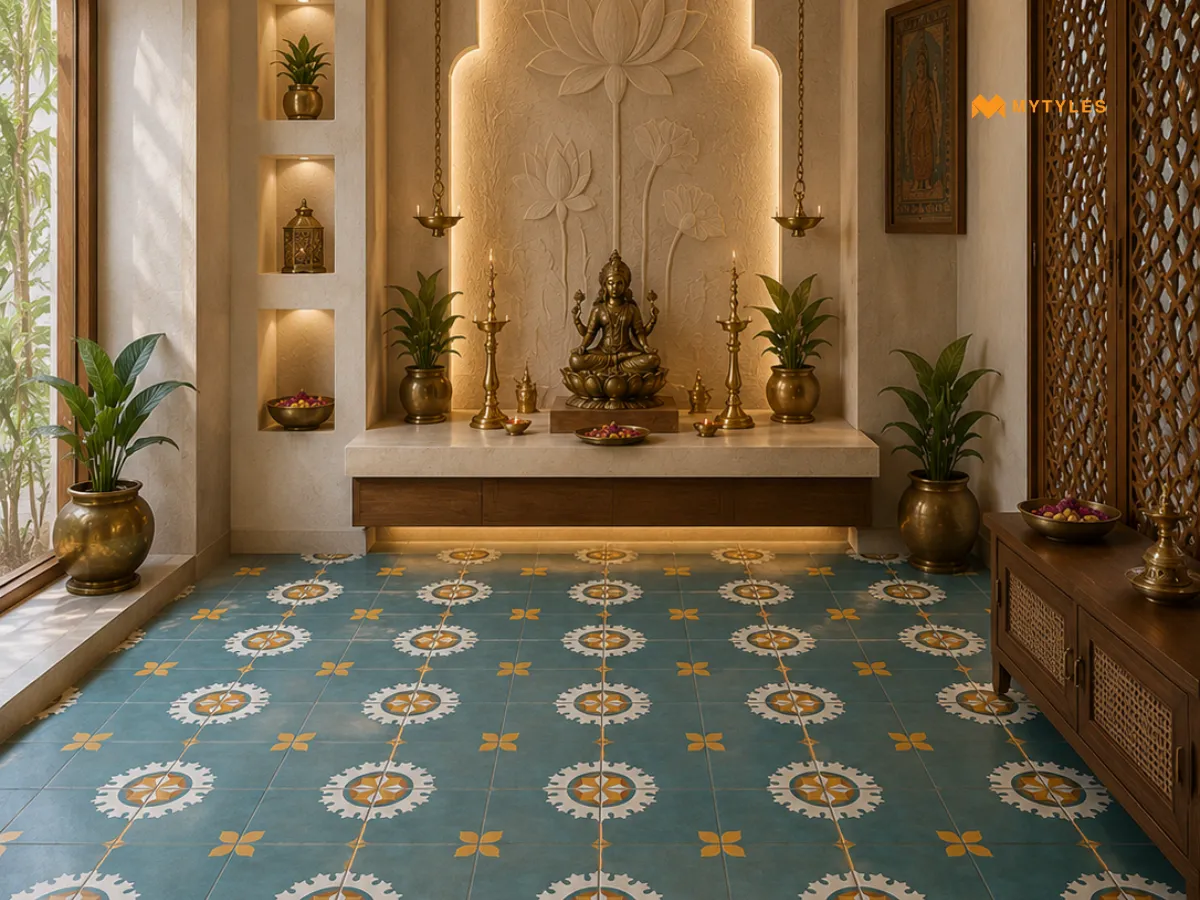
One of the defining qualities of Athangudi tile design ideas is the precision of their repeat patterns. Though handmade, the pattern is designed so one piece flows into the next without a visual gap. Across a full floor, this reads like a woven surface. In traditional Indian pooja room design, that kind of visual continuity is not just aesthetic; it speaks to order, balance, and care.
A paisley grid, a temple arch repeat, or a stylised lotus arranged in rows. Any of these, when laid in a symmetrical pattern, produces a floor that stops people before they even step fully inside. It signals that someone thought about this space. That matters in a room meant for quiet and focus.
Design tip:
Before finalising a repeat tile pattern, lay out at least 9 tiles (3x3) to see how the repeat connects. Grout color ideas matter here too. A grout that closely matches the tile keeps the surface looking continuous, while a contrasting grout emphasises the grid.
Blue and White Tiles for a Serene, Classic Pooja Room
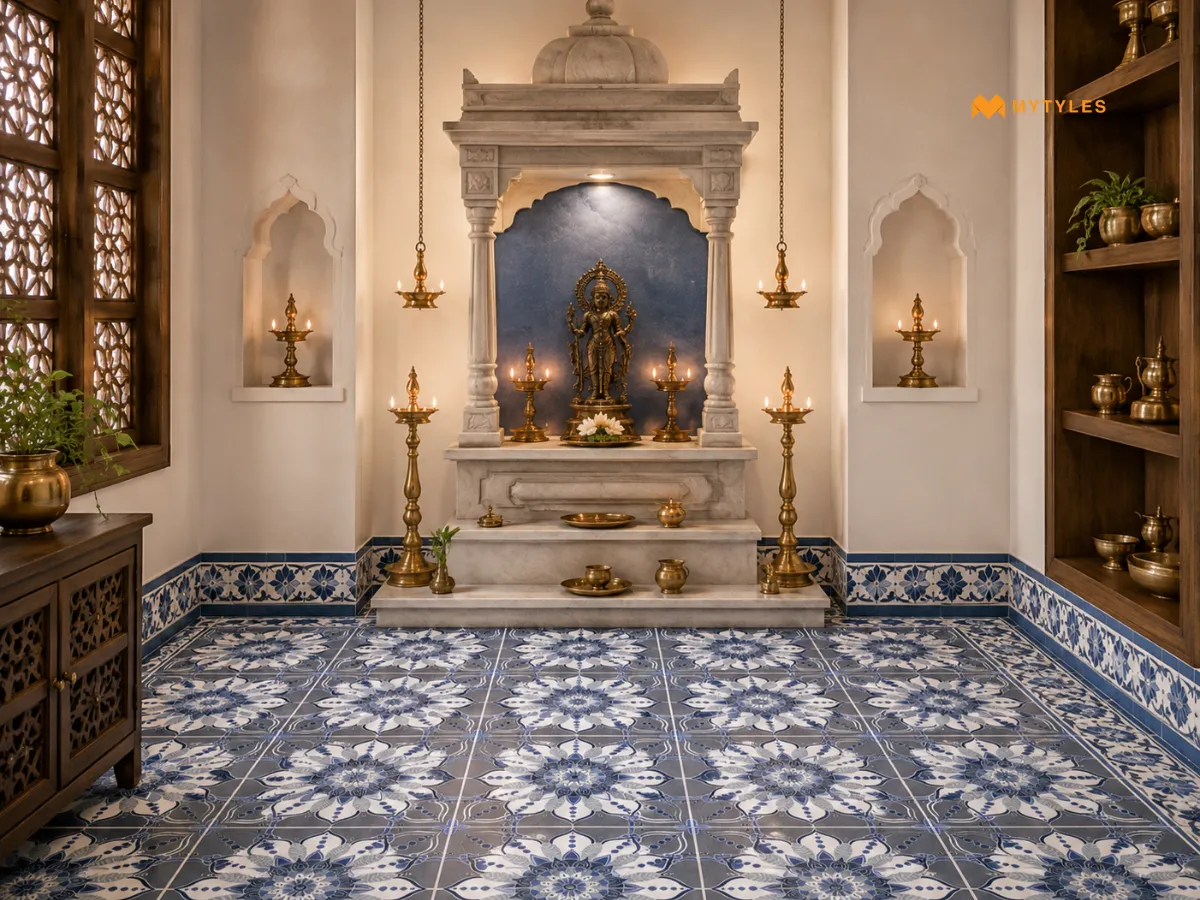
The blue and white combination has moved through Indian craft for centuries without ever feeling dated. You find it in Kutch embroidery, Jaipur pottery, and Thanjavur painting. In the context of Athangudi tiles for home mandir spaces, these two colours together bring something specific: a quietness. Not cold, not bare. Just still. Which is exactly what a mandir should feel like.
As mandir floor tiles or mandir wall tiles, blue and white Athangudi designs sit differently in different lights. Morning light warms the blue slightly. Afternoon turns it deeper. Pooja rooms with a window facing east are especially well-suited to this combination.
Design tip:
Pair blue and white Athangudi tiles with raw wood or dark teak for the mandir unit. The combination of cool tile tones against warm wood creates a balance that feels both traditional and refined.
Mixed Pattern Layouts for a Curated Heritage Look
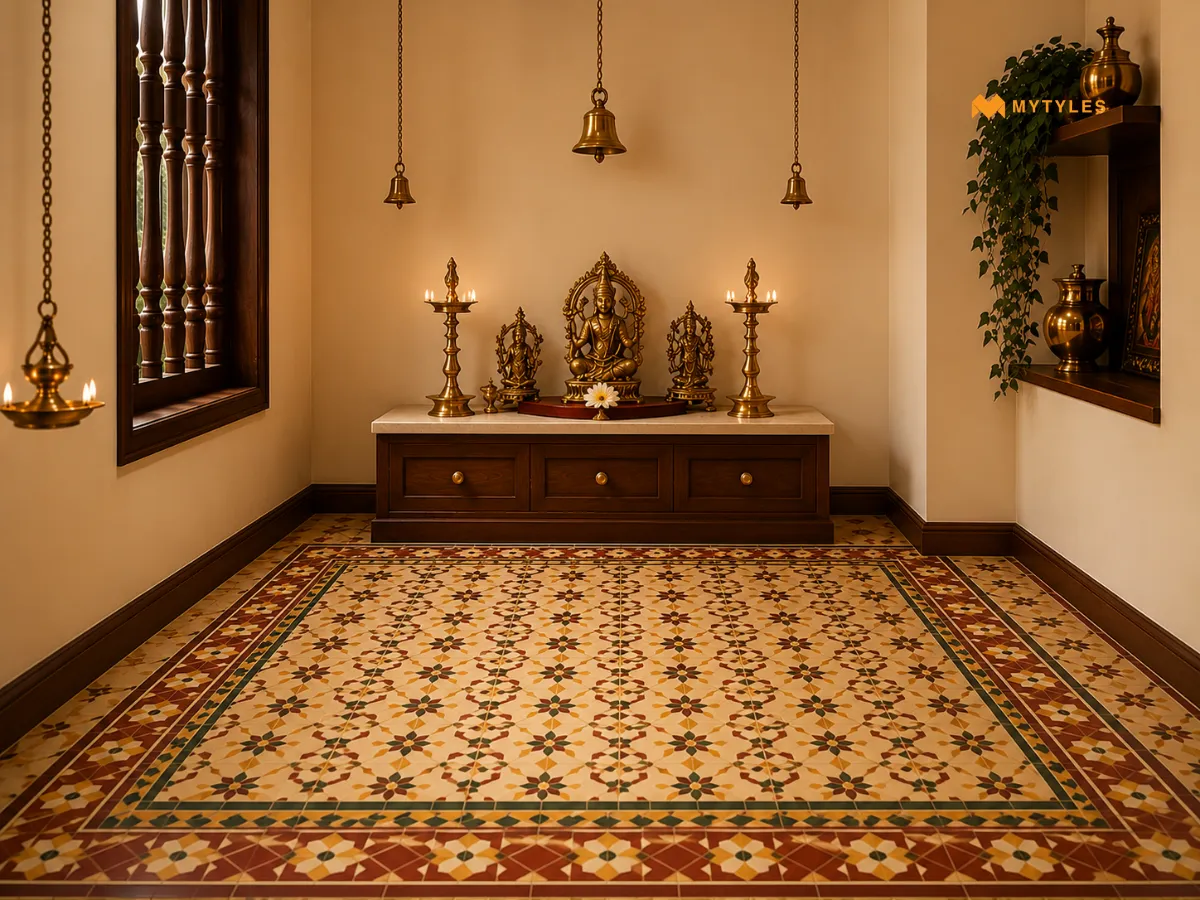
Skilled interior designers often mix two or more Athangudi tile ideas for pooja rooms within the same space. A border in one pattern, a central field in another, and perhaps a small accent strip near the base of the wall. Done with care, this layered approach produces a look that feels like it belongs in an old ancestral home.
This is one of the more nuanced pooja room tile ideas, and it works best when all the tiles share a similar colour palette, even if the patterns differ. Mixing warm tones across different designs keeps the space cohesive rather than chaotic
Design tip:
When mixing patterns, stick to two or three tile designs at most. Always choose patterns at different scales: one large, one medium, one small. And use the same tile adhesive across all tiles to ensure consistent depth and finish across the mixed layout.
Accent Border Strips for Pooja Rooms That Need a Subtle Detail
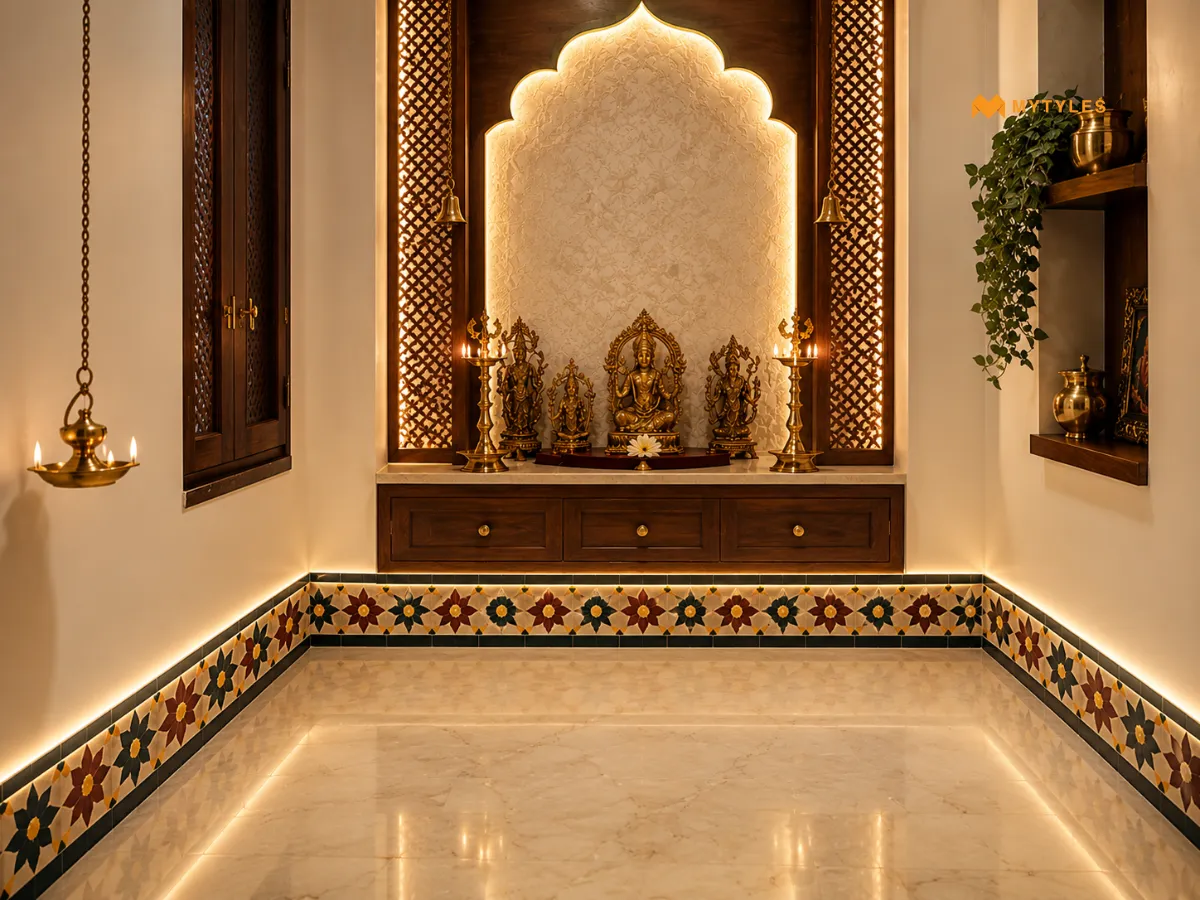
Not every pooja room needs a fully tiled floor or wall. Sometimes a single horizontal border running along the base of the wall, or framing the mandir niche, is enough to bring in the Athangudi character without a full installation.
A border strip in a geometric or floral Athangudi pattern at skirting level ties the floor and wall together visually. It works particularly well in pooja rooms where the floor is plain stone or marble and the homeowner wants to bring in some pattern without replacing what is already there.
Design tip:
Keep the border width proportional to the room. A strip between 4 to 6 inches tends to read well in most standard pooja room sizes. Going wider can make it look like an unfinished floor tile job rather than an intentional design choice.
Things to Keep in Mind Before Tiling Your Pooja Room
Choosing your Athangudi tiles for the pooja room is the creative part. The practical side matters just as much. Here are a few things worth knowing before you start.
- Athangudi tiles are handmade, so minor colour and size variations are normal. Always buy from a single batch where possible to maintain visual consistency.
- Seal the tiles after installation. Athangudi tiles are made from natural pigments and white cement. Sealing them protects the colour and makes the surface easier to clean.
- A heritage tile design earns its full effect only when the room around it cooperates. The mandir unit, the wall colour, the lighting, these either support the tile or fight it. Simple surroundings almost always win.
- Decorative tiles for pooja room walls should stay in dry zones. Since Athangudi tiles are made from natural pigments, they sustain water contact, which affects both the colour and the surface over time. So, keep them away from any area that sees regular splashing or moisture.
Bring the Beauty of Handmade Tradition Into Your Pooja Room
Athangudi tiles carry something most tiles do not. A background. A history. A place they come from. Bringing them into a pooja room is not just about aesthetics; it is about choosing a material that already understands what the space is for. Whether the floor gets fully tiled or just bordered, the right Athangudi tile changes how the room feels from the moment you step in.
At MyTyles, the collection includes traditional Indian tiles selected with Indian homes in mind, including Athangudi-inspired designs across sizes, patterns, and colour palettes. Browse pooja room tiles online at your own pace, or walk into the nearest MyTyles experience centre and see what these tiles actually look like before you commit.
Expert Reviewed by Biren Agrawalla
Biren Agrawalla, the Founder of MyTyles with over 10 years of experience across tile, retail, and home decor. Driven by a passion for tiles and a deep understanding of customer behaviour, he has spent his career transforming how people discover and buy tiles online. Biren combines practical retail insight with modern digital solutions to make tile shopping smarter, more intuitive, and design focused. At MyTyles, he champions a customer first approach, ensuring every experience from browsing to buying is reliable, seamless, and inspiring.

What Are Athangudi Tiles?

Traditional Athangudi tiles are handmade cement-based tiles associated with Athangudi in Tamil Nadu. They are commonly produced using cement, sand, pigments, and patterned moulds placed over a glass surface. Floral and geometric motifs are widely seen in this craft. Athangudi-inspired tiles recreate a similar design language but may use different materials and manufacturing methods.
Can Athangudi-Inspired Tiles Be Used in Pooja Rooms?
Athangudi-inspired tiles can be considered for pooja room floors, feature walls, borders, and the wall behind the mandir. Yet, their suitability depends on the tile material, finish, installation surface, and the manufacturer’s recommended application. Check these details before selecting a design, particularly when the tile will be placed near lamps, water, or frequently cleaned areas.
Which Colors Work Well for Athangudi-Inspired Pooja Room Tiles?
Red, green, blue, grey, terracotta, cream, and mustard-toned combinations are often associated with Athangudi-style patterns. The selection can be based on the mandir finish, wall color, lighting, and the size of the pooja room. A limited color palette may suit smaller spaces, while broader patterns can be considered where there is more visible floor or wall area. Traditional Athangudi tiles commonly feature red, blue, green, and grey tones.
Can Athangudi-Inspired Tiles Be Used on Pooja Room Walls?
Yes, products approved for wall installation can be used behind the mandir, along a lower wall section, or as a decorative border. However, not every floor tile is automatically suitable for wall installation. Tile weight, thickness, surface preparation, and the recommended adhesive should be checked with the seller or installer before work begins.
How Should Athangudi-Inspired Pooja Room Tiles Be Maintained?
Maintenance should follow the instructions provided for the selected tile material and finish. For routine cleaning, loose dust can be removed first, followed by wiping with a soft cloth or mop and a suitable mild cleaner. Also, avoid assuming that every Athangudi-inspired tile requires sealing, polishing, or the same cleaning method, as these requirements can differ between handmade cement tiles, ceramic tiles, and vitrified alternatives.
What Sizes Are Athangudi-Inspired Tiles Available In?
There is no single standard size for every Athangudi or Athangudi-inspired tile. Dimensions depend on the manufacturer, material, motif, and intended application. Square formats are commonly used for repeating floor patterns, while rectangular or smaller pieces may be offered for walls, borders, and accent sections. Check the product listing for the exact size, thickness, and coverage before calculating the required quantity.
Can Different Athangudi-Inspired Patterns Be Mixed in One Pooja Room?
Different patterns can be combined, but the layout should be planned before installation. One design may be used for the main floor or wall area, while another is kept for the border or central panel. Repeating one or two colors across the patterns can make the arrangement feel more connected and prevent the smaller pooja room from appearing overly busy.

ABOUT THE AUTHOR
Heena Dhiman
With a background in fashion design and over 5 years of writing experience, I bring a creative and detail-oriented eye to home and design content. My journey began with aesthetics, colours, and visual storytelling, which gradually led me to writing across lifestyle, finance, home improvement, and resource management. Over time, I discovered a strong interest in tiles and interiors, where my design background helps me understand how small choices can shape the feeling of a home. Through my content, I aim to make home design decisions easier, clearer, and more enjoyable for readers, helping them feel confident while creating spaces that reflect their style and everyday needs.