.svg)


Moroccan Kitchen Tiles: Adding Colour & Pattern to Indian Kitchens
ByHeena Dhiman

Thu , Jun 04 , 2026

Read Time: 5 Min


 Copied!
Think about the last time a kitchen truly stopped you in your tracks. Chances are, the walls had something to say. Moroccan kitchen tiles have a way of doing that. Rooted in centuries of North African artisanship, they carry bold geometry, vivid colour, and a kind of pattern that feels alive. And somehow, they feel right at home in Indian kitchens too.
Both cultures share a deep love for detail, colour, and spaces that feel warm and full of personality. So, no matter if you have a compact modular kitchen or a large open one, Moroccan tiles can add character to your walls and backsplash that you simply can't get from plain tiles.
What Makes Moroccan Kitchen Tiles Different?
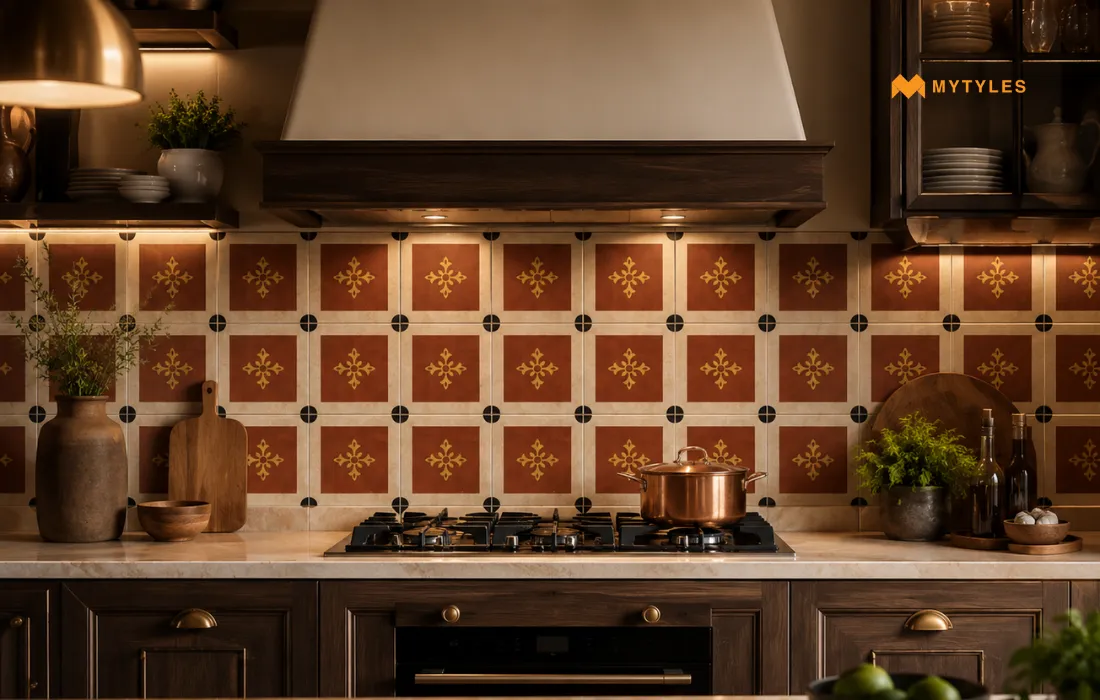
Most kitchen tiles do their job quietly. They protect the wall, they clean up easily, and they stay out of the way. Moroccan kitchen tiles do all of that, but they also do something more. They draw you in.
The patterns come from a centuries-old tradition of Islamic geometric art, where shapes like stars, hexagons, and interlocking diamonds are repeated across a surface to create something that feels almost meditative to look at. Add to that the colours, like deep blues, warm terracotta, earthy greens, crisp black and white, and you have a tile that does not just cover a wall but genuinely decorates it.
This is also why Moroccan kitchen tile design feels so compatible with Indian interiors. Also, since Indian homes have always celebrated patterns and colors, a Moroccan backsplash does not feel foreign here. It feels like a natural extension of that sensibility.
Types of Moroccan Kitchen Tiles Worth Knowing About
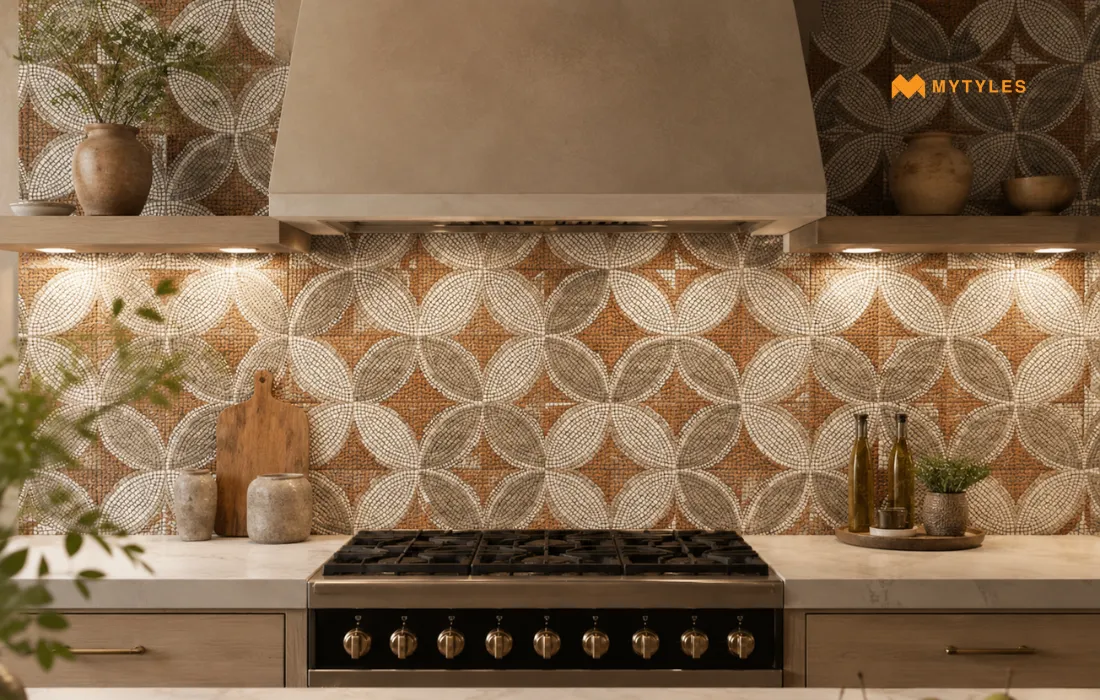
Before you start planning your kitchen makeover, it helps to understand the different types of Moroccan tiles available. Each tile brings its own look and suits a different kind of kitchen.
Zellige Tiles
Zellige are handmade ceramic tiles with a slightly uneven, glossy surface. Each tile is individual, which means the glaze catches light differently from piece to piece. This gives a wall an almost shimmering, living quality. Colorful Moroccan kitchen tiles in zellige are ideal if you want warmth and texture. They work beautifully behind the hob or along the length of the backsplash.
Cement Tiles
Cement tiles are made by pressing a coloured cement mixture into moulds. They come in bold, flat patterns and are best known for the characteristic matte finish. Traditional Moroccan kitchen tiles often come in cement form, and they suit kitchens with a rustic or earthy vibe. They are great for floors too, though in Indian kitchens they are most commonly used as decorative wall tiles.
Ceramic Moroccan Pattern Tiles
These are factory-made ceramic tiles with a Moroccan-inspired print or relief pattern. They are more consistent in size and finish than zellige, which makes installation easier. Modern Moroccan kitchen tiles in ceramic form are widely available across India, are more budget-friendly, and come in a huge range of colours and pattern scales. They are also easy to clean and stain-resistant, which matters a lot in a working kitchen.
Arabesque or Lantern-Shaped Tiles
Named after their distinctive pointed oval shape, arabesque tiles are instantly recognisable. When laid together, the shape creates a repeating pattern all on its own, even without any printed design. They are one of the best Moroccan tiles for kitchen backsplash areas because they add dimension and interest without overwhelming the space.
Where to Use Moroccan Kitchen Tiles in Your Home
.webp)
One of the most common questions homeowners ask is how to use Moroccan tiles in the kitchen without making it feel too busy. The answer is simple: pick one area and commit to it.
Behind the Hob
The wall behind the cooking range is the most visible surface in any kitchen. It is also the one that takes the most heat, steam, and splatter. Tiles behind the kitchen hob need to be heat-resistant kitchen tiles, and are easy to wipe down. Moroccan tiles fit both requirements well. A bold geometric pattern here becomes the natural centrepiece of the kitchen.
Kitchen Backsplash
Moroccan backsplash tiles are probably the most popular way to bring this style into an Indian kitchen. The backsplash runs along the counter, connecting the lower cabinets to the upper ones. It is wide enough to show off a pattern but bounded enough that it does not take over the room. Moroccan tiles for kitchen backsplash tend to work best when the surrounding cabinets are kept simple, white, grey, or wood-toned.
Behind the Sink
The area behind the sink is constantly exposed to water and light. Moroccan wall tiles for the kitchen work wonderfully here, especially in cooler blue or green tones that feel fresh and clean. These are naturally waterproof kitchen wall tiles, particularly in glazed ceramic or zellige form, so they handle splashes without a problem.
Accent Strip or Feature Wall
If you are not ready for a full backsplash in Moroccan patterned kitchen tiles, a narrow horizontal strip running across the wall at eye level can be just as effective. It adds a band of colour and pattern without completely changing the look of the kitchen.
Moroccan Tiles for Small Indian Kitchens
.webp)
A question that comes up often: can you use bold tiles in a compact space? The answer is yes, and when done right, it can actually make a small kitchen feel more intentional and designed.
Moroccan tiles for small Indian kitchens work best when you use them in one focused spot, typically the backsplash or the wall behind the hob, rather than on every surface. Stick to a tile with a medium-scale pattern rather than an oversized one. Lighter colour combinations, white and blue, white and green, or white and black, keep the space feeling open while still adding character.
Moroccan tiles for modular kitchens also pair very naturally with the clean, structured look of modular cabinetry. The orderly geometry of the tile pattern echoes the straight lines of the modules, so the two elements balance each other out rather than competing.
How to Choose Moroccan Kitchen Tiles for Your Space
Choosing the right tile is not just about picking a pattern you like. A few practical questions can help you land on the best Moroccan tiles for your kitchen.
- What is the overall style of your kitchen?
Traditional Moroccan kitchen tiles in earthy tones and bold patterns suit warmer, more eclectic spaces. On the other hand, modern Moroccan kitchen tiles in clean black and white or monochrome palettes work better in contemporary modular kitchens.
- How much natural light does your kitchen get?
A brightly lit kitchen can handle richer, deeper colours. A kitchen with less light benefits from lighter tile combinations that reflect whatever little brightness there is.
- What are the practical demands of space?
The tiles you use behind the hob should be heat-resistant and glossy enough to wipe clean easily. Matt cement tiles are beautiful but need a little more care in high-splatter zones.
- How big is the area you want to tile?
A large backsplash can carry a bold, complex pattern. A narrower strip or a small niche area looks better with a simpler, smaller-scale design.
Why Moroccan Kitchen Tiles Work So Well in Indian Kitchens
Indian kitchens are spaces that come alive with activity. There is colour on the shelves, warmth from the stove, and the constant movement of someone cooking something that smells wonderful. Moroccan tiles for Indian kitchens feel at home in this environment because they were made for spaces that are lived in.
The patterns do not fade into the background. They participate. The geometric kitchen tile patterns echo Indian rangoli and jaali work. The colours feel familiar, turmeric yellows, deep indigo blues, terracotta reds. And because the tiles are glazed and sealed, they are genuinely easy-to-clean kitchen tiles that hold up well to the oil, steam, and spices that are part of everyday Indian cooking.
Whether you are tiling a traditional home in Rajasthan or a modular kitchen in a Mumbai apartment, these tiles bring a layer of craft and intention that changes how the space feels.
Transform Your Kitchen into a Space Worth Loving with Moroccan Pattern Tiles
Your kitchen deserves more than just functional surfaces. Moroccan kitchen tiles give you colour, pattern, and personality in a format that is durable, easy to maintain, and genuinely beautiful. From a bold Moroccan backsplash behind the hob to a delicate arabesque strip above the counter, there is a way to bring this style into your kitchen that feels right for your home.
At MyTyles, we carry a carefully chosen collection of decorative Moroccan kitchen wall tiles that are suited for Indian homes and lifestyles. You can visit the MyTyles experience centre or buy Moroccan kitchen tiles online to make your kitchen feel exactly the way you want it to.
Expert Reviewed by Biren Agrawalla
Biren Agrawalla, the Founder of MyTyles with over 10 years of experience across tile, retail, and home decor. Driven by a passion for tiles and a deep understanding of customer behaviour, he has spent his career transforming how people discover and buy tiles online. Biren combines practical retail insight with modern digital solutions to make tile shopping smarter, more intuitive, and design focused. At MyTyles, he champions a customer first approach, ensuring every experience from browsing to buying is reliable, seamless, and inspiring.

Are Moroccan Tiles Good for the Kitchen?

Yes. Moroccan tiles are durable, easy to clean, and heat-resistant, which makes them well-suited for kitchen use. Glazed ceramic versions handle splatter and steam well and are a practical, stylish choice for backsplashes and walls.
How Do I Use Moroccan Tiles in a Small Indian Kitchen?
Use them on one focused surface, the backsplash or the wall behind the hob. Choose a lighter colour combination and a medium-scale pattern. This adds character without overwhelming a compact space.
What is the Best Placement for Moroccan Kitchen Tiles?
The backsplash and the wall behind the hob are the most popular and practical spots. They are highly visible, easy to clean, and the right size to show off a pattern without overdoing it.
How Do I Choose Moroccan Kitchen Tiles for My Home?
Consider your kitchen's overall style, the amount of natural light, and the practical demands of the space. Bold patterns suit eclectic kitchens; clean geometric designs work well in modern modular ones. Match the tile finish to the zone: glossy for high-splatter areas, matt for drier spots.
Can Moroccan Tiles be Used in a Modular Kitchen?
Absolutely. Moroccan tiles for modular kitchens pair naturally with the clean lines of modular cabinetry. The geometric pattern of the tile complements the structured look of the modules without clashing.
What Colors are Available in Moroccan Kitchen Tiles?
Moroccan tiles come in a wide range, from deep blues, warm terracotta, and earthy greens to classic black and white. Both traditional rich tones and modern neutral combinations are widely available for Indian kitchens.
Are Moroccan Kitchen Tiles Easy to Maintain?
Yes. Glazed ceramic Moroccan tiles are stain-resistant, waterproof, and simple to wipe clean with a damp cloth. They hold up well to the heat and moisture common in Indian kitchens, making maintenance hassle-free.

ABOUT THE AUTHOR
Heena Dhiman
I started out in fashion design before finding my true calling in writing. My background taught me to look at spaces differently, with a keen eye for details and aesthetics. With over 5 years of experience, I have written content across diverse niches, from lifestyle, finance, and home improvement to project and resource management. Along the way, I discovered an interest in tiles and home design, where my creative background comes in handy. Currently, I am working towards making home design decisions less overwhelming and more enjoyable through my content pieces.
Latest Blogs By MyTyles