.svg)


History of Tiles: From Ancient Civilisations to Modern Homes
ByAditi Bardhan

Wed , Jun 03 , 2026

Read Time: 5 Min


 Copied!
Tiles are such a common part of our homes that we rarely think about their story. We walk on them every day and see them in our bathrooms, kitchens, balconies, living rooms, staircases, and outdoor spaces without giving them much thought. But tiles have been around for far longer than most people realise.
Tiles were used long before they became part of modern homes, in palaces, temples, public baths, courtyards and other amazing buildings. These have been carefully crafted from clay, featuring intricate designs and often reflecting the culture, beliefs, and artistic traditions of the time.
Tiles are not only a floor or wall cover, but they also have a history. It is the story of how people learnt to combine beauty with function. From ancient clay tiles to today’s vitrified, porcelain and digitally printed designs, tiles have travelled through centuries while still remaining one of the most useful materials in home design.
The Early Origins of Tiles
The first tiles were basic and functional and were constructed from natural materials. Clay was one of the first materials used, as it was readily available and could be moulded by hand. After drying and firing, it was strong enough to be used for covering floors, walls and other surfaces.
The early tiles were not neat and tidy. They were coarse, irregular and earth colored. Some had hand marks on them. Some had small cracks. Some of them may have appeared a bit wacky. But they worked. They protected floors, covered walls and made everyday spaces easier to live in.
The early tiles were primarily used for:
- Covering floors and walls
- Making indoor spaces cleaner
- Increasing durability of surfaces
- Adding basic decoration
- Use of locally available clay and natural materials
With time the people experimented with heat, color and pattern. Clay tiles were baked in a kiln to produce greater hardness. As time passed, simple surfaces became more decorative. What started off as a construction material slowly became an art form.
The Rise of Ceramic Tiles
With the improvement of the techniques of making tiles, ceramic tiles grew in popularity. Clay can now be formed more precisely, fired at higher temperatures and glazed. This rendered tiles more suitable for everyday use, as it increased their strength and smoothness.
The use of glazing was a big breakthrough. It made the tiles more colorful, easy to clean and water-resistant. They were great for use in kitchens, bathrooms, courtyards and other spaces that required some level of protection.
Ceramic tiles became popular because they offered the following:
- Better durability
- More color and design options
- Improved water resistance
- Easier cleaning
- A smoother finish
- More decorative possibilities
Over the years ceramic tiles came to be not only a feature of royal buildings but also of temples and public spaces. They gradually started entering the interiors and homes.
Tiles in Medieval and Renaissance Architecture
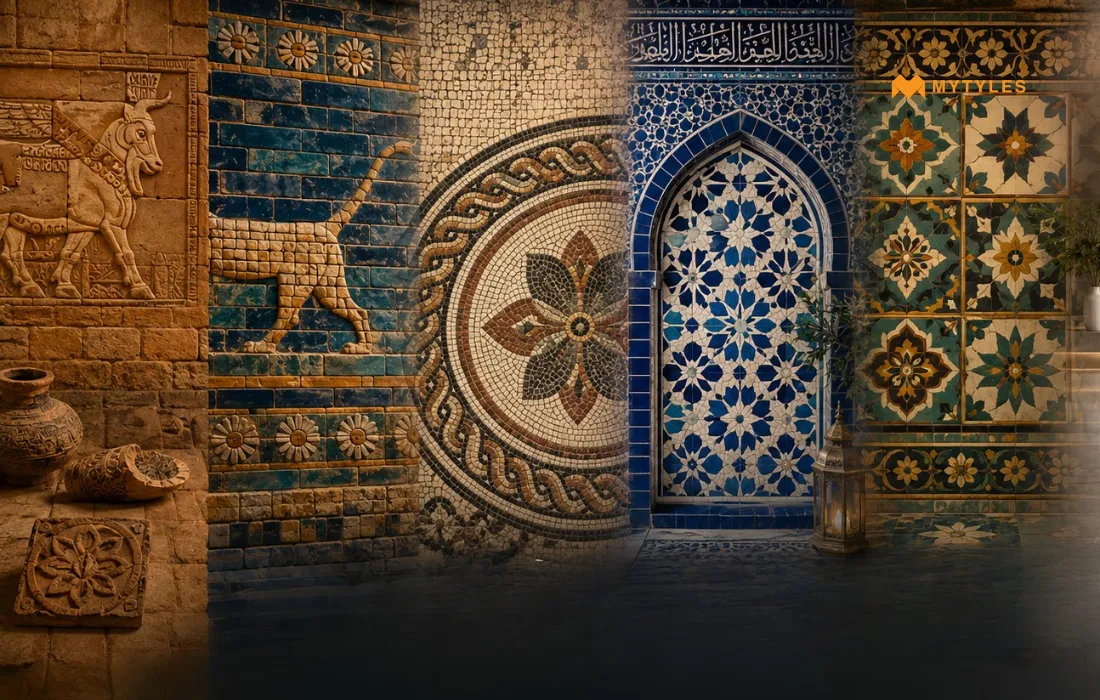
Tiles became more artistic during the mediaeval and renaissance times. Churches, palaces, courtyards and affluent houses were decorated with hand-painted tiles. Often featured floral designs, religious symbols, borders, geometric shapes, and scenes from everyday life.
This was also when other regions began to develop a local tile style. Each of the different tiles, Spanish, Italian, Persian, Dutch and Portuguese, had a different style. Some were bold and colored and others were delicate and detailed.
The Industrial Revolution and Mass Production
The Industrial Revolution had a huge impact on the tile industry. Most of the tiles were made by hand prior to the advent of machines and factories. This made them costly and not easy to make in large quantities. New manufacturing techniques helped to make tiles cheaper and quicker. The factories would be able to make tiles of standard size, better quality and repeatable designs. This made the tiles affordable for common people.
Tiles became more popular with mass production, which provided the following:
- Faster production
- Lower costs
- Standard sizes
- Better consistency
- More design options
- Easier access for homeowners
It was a significant change. Tiles became available even for small buildings or homes for middle-class people. They were then adopted for use in kitchens and bathrooms, as well as for floors, walls and public space.
The Evolution of Tiles in Indian Homes
India has its own rich connection with tiles and surface design. Materials like natural stone, terracotta, handmade clay tiles, cement tiles, and mosaic flooring were used in traditional houses of India. Temples, palaces, courtyards and old homes often featured beautiful floor patterns and handcrafted surfaces.
Over the years, Indian homes began moving towards ceramic, vitrified and porcelain tiles. This shift happened because modern tiles are easier to maintain, more consistent in finish and available in far more designs. Today, tiles are used across almost every part of Indian homes.
The selection of tiles has also shifted toward a more style-orientated approach. Homeowners are now seeking designs that are compatible with their interior decoration and lifestyle. This is because marble-look tiles look great in living rooms, wooden tiles are ideal for bedrooms, kitchen wall tiles are easier to clean and anti-skid tiles are better suited for bathrooms and balconies.
Modern Tiles: Where Design Meets Performance
Modern tiles are very different from the early handmade versions. Today, tiles are produced by modern, superior technology and with more refined materials and finishes. Ceramic, porcelain and vitrified tiles are now available in many sizes, colors, textures and surfaces.
One of the biggest changes is digital printing. It allows tiles to recreate the look of natural materials such as marble, wood, stone, cement, terrazzo and fabric. This gives homeowners more design freedom without the high maintenance that some natural materials need.
Popular modern tile options include the following:
- Vitrified tiles
- Porcelain tiles
- Ceramic wall tiles
- Marble-look tiles
- Wooden finish tiles
- Stone-look tiles
- Anti-skid floor tiles
- Large-format tiles
- Textured tiles
- Glossy and matt finish tiles
Modern tiles are not just selected for aesthetic purposes. They should also demonstrate good performance. A tile must be able to withstand the use, moisture, cleaning, temperature variations and daily foot traffic.
How Tile Designs Have Changed Over Time
.webp)
Over the centuries, the design of tiles has evolved significantly. The former tiles were hand-made and were smaller and frequently of an irregular shape. Most designs were created on-site, and colors were also limited. Today, tiles are much more precise. They are available in standard sizes, large formats, slim profiles and detailed finishes. These designs can be simple, dramatic, rustic, elaborate, traditional or minimal, depending on the room.
Some major changes in tile design include the following:
- Handmade shapes have become more precise and machine-cut.
- Limited colors have turned into wide color palettes.
- Clay and stone joined with ceramic, porcelain and vitrified materials.
- Small decorative tiles have turned to large-format slab tiles.
- Hand-painted patterns have been joined by digital prints.
- Traditional motifs now sit alongside modern, minimal designs.
The largest distinction lies in choice. The availability of materials and local craft were the primary factors affecting the design of tiles before. Today, it's a matter of lifestyle, room function, interior theme and taste.
Why Tiles Are Still Popular Today
Tiles have remained popular because they offer a rare balance of beauty and practicality. They can be stylish without being difficult to maintain. They can be used in wet areas, dry areas, indoor spaces and outdoor corners when the right type is selected.
Homeowners continue to choose tiles because they are:
- Durable
- Easy to clean
- Available in many styles
- Suitable for floors and walls
- Practical for Indian homes
- Useful in both wet and dry areas
- Available in different sizes, colors and finishes
Tiles also give a lot of design freedom. A light-colored tile can make a compact room feel open. A dark tile can add depth. A marble-look tile can create a premium feel. A patterned tile can turn a plain wall into a highlight area.
This flexibility is one of the reasons tiles continue to work so well in modern interiors.
Bringing Centuries of Tile Craft into Modern Homes
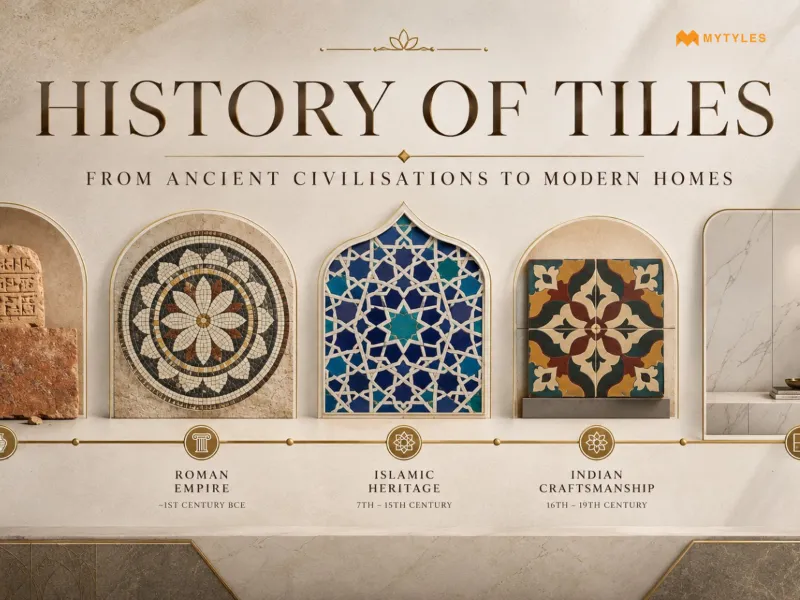
The story of the tile is one of craft, culture, technology and design. From ancient clay tiles and Roman mosaics to Islamic tile art, hand-painted ceramics and today’s vitrified and porcelain tiles, every stage has added something valuable to the way tiles are made and used. Tiles are special because they 'never lose their purpose'! As functional surface materials, they have evolved over time to be a design element that can provide a space with personality, meaning, texture and color. They have journeyed from ancient clay floors to modern beautifully finished floors and walls. You can now enjoy that sense of craft, style and durability in your own home with MyTyles. Shop wall and floor tiles online with MyTyles and discover designs that give a traditional feel and are an ideal fit for contemporary rooms.

What Is The History Of Tiles?

The history of tiles goes back thousands of years, when early civilisations used clay, stone and fired earth to make stronger surfaces. Tiles first served practical needs, such as covering floors, protecting walls and keeping buildings cleaner. Over time, people added color, glaze, patterns and detailed artwork, turning tiles into both a useful material and a design craft.
Who First Invented Tiles?
Tiles were not invented by one person. Early forms of tiles developed in ancient civilisations where people used clay and natural materials for building surfaces. Mesopotamia, Egypt, Greece, Rome and later Islamic regions all shaped tile history in different ways. Each culture improved tile-making through firing, glazing, pattern work and decorative use in homes, temples and public buildings.
Why Were Tiles Used In Ancient Civilisations?
Ancient civilisations used tiles because they made buildings stronger, cleaner and easier to maintain. Clay and stone tiles protected floors and walls from wear, water, heat and dirt. They also helped important buildings look more finished. In temples, palaces and public spaces, tiles often showed wealth, skill, belief and cultural identity through color, patterns and detailed designs.
How Did Tiles Change Over Time?
Tiles changed from simple handmade clay pieces into highly designed surfaces used across homes and buildings. Early tiles were rough and practical, but later makers added firing, glazing, color and patterns. Roman mosaics, Islamic geometric tiles, Dutch painted tiles and modern porcelain tiles all show how tile-making became more artistic, durable and suitable for different design styles.
What Are The Oldest Types Of Tiles?
The oldest types of tiles were usually made from clay, stone or fired earth. These early tiles were shaped by hand and used for floors, walls and roofs. Many were uneven and simple, but they helped protect surfaces and improve daily living. Later, glazed bricks and decorative ceramic tiles appeared in ancient buildings, temples, palaces and public spaces.
How Did Tiles Become Popular In Modern Homes?
Tiles became popular in modern homes because they are durable, easy to clean and suitable for many rooms. Industrial production made tiles more affordable and available in regular sizes. Later, digital printing created marble-look, wood-look, terrazzo-look and stone-look tiles. Today, homeowners use tiles in kitchens, bathrooms, balconies, living rooms, bedrooms and outdoor areas.
Why Are Tiles Still Used Today?
Tiles are still used today because they offer a rare mix of strength, style and easy maintenance. They handle moisture, heat, stains and daily wear better than many other surface materials. Tiles also come in many colors, sizes, textures and designs, which makes them useful for both traditional homes and modern interiors across floors, walls and outdoor spaces.

ABOUT THE AUTHOR
Aditi Bardhan
I'm Aditi Bardhan, a professional content writer with over five years of experience creating SEO-driven, research-backed content across multiple industries. I specialise deeply in the tile and surface materials industry, crafting high-converting content for homeowners, architects, interior designers, and trade professionals. My work is grounded in technical research, design understanding, and consumer behaviour insights, enabling me to simplify complex concepts, highlight material benefits, and help brands build authority in the tile and construction space.
Latest Blogs By MyTyles